.png)
Adam Grant Book Recommendations 2026: The Spring & Summer Reading List That Will Rewire How You Think
Updated: May 3

There's a particular kind of book that doesn't just fill your head with new information. It rewires something deeper. It shifts the lens. It makes you see an old problem with entirely new eyes. Adam Grant has built a career on finding those books, and his spring and summer 2026 reading list is no exception.
Twelve books. Four categories. One underlying ambition: to help you build a better life and a better world. This is Adam Grant's definitive reading list for spring and summer 2026 and if you've been searching for what to read next, you're in exactly the right place.
These are not comfortable reads. They ask something of you. They ask you to sit with uncertainty, question your assumptions, laugh at your neuroses, and then do something about it.
One of them will even change the way you think about your gut. Let's get into all of them.
Adam Grant's Spring 2026 Book Releases: Nonfiction That Arrives at Exactly the Right Moment
Grant frames the distinction between a good book and a great book simply: a good book introduces you to an exciting world. A great book introduces you to an exciting worldview. Every title on this list earns that second designation. The spring 2026 nonfiction releases he's selected sit at the intersection of science, psychology, ethics, and lived experience — and taken together, they form something close to a complete philosophy for navigating modern life.
The list is organised into four pillars: a better future, success, mental health, and physical health. We'll move through all twelve, with full summaries, chapter-by-chapter breakdowns, who each book is for, and practical exercises you can apply the same day you finish reading.
Adam Grant's Spring & Summer 2026 Reading List: Book Summaries at a Glance
Book Title | Author | Theme | Key Learning Outcome |
Simone Stolzoff | Mental Health & Resilience | We live in an era of performative certainty where information environments systematically reward confident assertion over honest inquiry — the intolerance of uncertainty it produces leads to worse decisions, more fragile beliefs, and greater anxiety, while epistemic courage — the practiced ability to sit with open questions — is both learnable and protective. | |
Kate Bowler | Mental Health & Grief | Joy is not the reward you receive when suffering ends but a practice that can coexist with darkness — it requires releasing the cultural demand that pain produce a redemptive narrative, learning to witness difficulty without fixing it, and building the capacity to notice what remains present and good even within genuine loss. | |
Gemma Correll | Mental Health & Anxiety | Anxiety loses power when it becomes visible — naming, mapping, and finding the specific comedy in your neuroses creates genuine cognitive distance from the internal characters that drive anxious experience, and humour is not a trivialisation of anxiety but a research-supported tool that changes its physiological and emotional signature. | |
David Epstein | Creativity & Innovation | Constraints are not obstacles to creative output but the engine of it — the human brain in unconstrained environments defaults to familiar patterns, while the right limits force deeper problem-solving, more original thinking, and breakthroughs that unlimited freedom consistently fails to produce. | |
Shawn Achor | Mindset & Performance | Beliefs are not passive reflections of circumstances but active architects of outcomes — they function as perceptual filters that determine what information we notice and act on, and the five beliefs most predictive of exceptional performance (agency, connection, growth, meaning, contribution) can be deliberately cultivated rather than simply inherited. | |
Valerie Fridland | Communication & Bias | The way we speak is a social signal that triggers rapid, automatic, and largely unconscious judgements about intelligence, competence, and character — accent-based discrimination is real and measurable, almost entirely unaddressed by existing diversity frameworks, and the linguistic diversity it suppresses is a genuine cognitive and cultural loss. | |
Dana Suskind | Parenting & AI | The most powerful developmental tool a child will ever have is not a device or app but a responsive human relationship — caregiver attunement during sensitive developmental windows builds the neural architecture for language, emotional regulation, and cognitive capacity in ways no technology can replicate. | |
Eric Ries | Ethics & Leadership | Ethical failure is primarily a systems design problem, not a character flaw — organisations go bad when incentive structures reward short-term outcomes, obscure individual accountability, and punish dissent, and the fix requires redesigning those structures rather than blaming the individuals they produce. | |
Elizabeth Dunn & Jiaying Zhao | Sustainability & Behaviour | The guilt-and-sacrifice framing of climate action has failed to produce the behaviour change the planet requires — people adopt and sustain sustainable behaviours when they are framed as pleasurable, identity-affirming, and social, making joy the most underused tool in the environmental movement. | |
Trisha Pasricha | Physical Health & Gut | The gut is a second brain housing 500 million neurons and producing roughly 95% of the body's serotonin — the bidirectional gut-brain axis means digestive health directly shapes mood, cognition, and immune function, and most people are unknowingly working against this system through posture, diet, stress, and habits they have never been given reason to question. | |
Chris Ballard | Physical Health & Resilience | Cold water immersion has credible evidence behind recovery and acute mood elevation but many popular claims significantly outpace the research — the most robustly supported benefit is psychological, not physiological: the repeated practice of voluntarily choosing discomfort builds a transferable relationship with difficulty that changes how practitioners respond to challenge across all domains of life. | |
Courtney Conley & Milica McDowell | Physical Health & Movement | Walking is not a consolation prize for people who cannot run but one of the most complete physical, cognitive, and emotional interventions available to a human being — modern life has structurally eliminated this fundamental biological behaviour from most people's daily routines, and restoring it requires environmental redesign rather than willpower, producing benefits for chronic pain, cardiovascular health, mood, and creative thinking that dedicated exercise sessions only partially replicate. |
Mental Health: The Books That Hold You and Push You at Once
How to Not Know by Simone Stolzoff Summary — The 2026 Guide to Embracing Uncertainty

Simone Stolzoff, a journalist who previously explored the psychology of work, turns in May 2026 to one of the defining anxieties of our moment: the intolerance of uncertainty. How to Not Know is a guide — part cultural critique, part practical philosophy, part reported journalism — to living well in a world that will not stop changing.
Stolzoff's central observation is that we live in an era of performative certainty. Social media rewards confident assertion. Political culture punishes nuance. Professional life often equates decisiveness with competence. And yet the evidence suggests that the most effective thinkers and leaders are those most comfortable sitting with ambiguity and updating their beliefs in the face of new information.
The book explores what Stolzoff calls the "certainty addiction" — the cognitive and emotional drivers that push us toward false resolution — and offers a set of practices for building what he terms "epistemic courage": the ability to say "I don't know" and mean it as a strength rather than a confession.
Who this book is for
For anyone exhausted by the pressure to have all the answers — leaders, therapists, journalists, students, parents, and anyone navigating a life that refuses to resolve neatly.
Key Principles from How to Not Know
In your next three meetings, replace at least one confident assertion with "I'm not certain about this, but here's my current thinking" — notice the reaction in the room and your own discomfort with the phrasing
Pick one belief you hold with high confidence — about your industry, your organisation, your team, or yourself — and write down in one paragraph: what evidence supports this? What evidence would change my mind? If you can't answer the second question, treat that as a warning sign
Set a weekly "uncertainty check" — every Friday, identify one thing you stated with confidence during the week that turned out to be incomplete or wrong — write it down, name what you learned, and share it with at least one colleague
The next time someone asks you a question you don't know the answer to, say "I don't know, let me find out" instead of reaching for the nearest plausible-sounding response — do this at least once this week and note how it lands
Find one topic where you've been performing certainty — in a meeting, on a team, in a relationship — and this week say out loud: "I've been less sure about this than I've been letting on" — then explain your actual current thinking
Write a "belief changelog" — a running document where you record when you change your mind about something significant, what caused the change, and what it cost you to hold the old belief — update it at least once a month
In any situation this week where group consensus is forming quickly around a confident position, ask one question that slows the process: "what would we have to believe for this to be wrong?" — ask it genuinely, not rhetorically
Identify the three topics where you are most susceptible to performative certainty — the rooms where you feel the pressure to have a strong view — and prepare a three-sentence honest summary of your actual epistemic state on each one before you walk in
Chapter-by-chapter summary of How to Not Know
Part One: The Certainty Addiction
Stolzoff opens by making the case that our collective intolerance of uncertainty is not merely a psychological quirk — it is a structural feature of the information environments we have built. Social media algorithms reward confident, declarative content over nuanced, conditional thinking. News cycles punish "I'm not sure yet" in favour of instant takes. Professional cultures treat certainty as a signal of competence even when the problems being addressed are genuinely unresolvable with current information. The result is a civilisation that has systematically devalued one of the most important cognitive capacities a person can possess.
We've built information systems that reward the performance of certainty over the practice of honesty.
Practical exercise: For one week, every time you're asked a question to which you don't actually know the answer, say "I don't know" before offering any response. Notice the social reaction — and your own discomfort. That discomfort is the certainty addiction making itself visible.
Part Two: Epistemic Courage
The middle section is where Stolzoff shifts from diagnosis to practice. He profiles a series of individuals — scientists, leaders, therapists, and ordinary people — who have developed a genuinely comfortable relationship with uncertainty, and extracts the common practices that allow them to operate effectively without the crutch of premature certainty. The central finding is that epistemic courage — the willingness to hold questions open, to update beliefs in the face of evidence, to resist the social pressure toward false resolution — is a learnable skill, not a fixed disposition.
The most intellectually honest people I know are not the ones with the most answers. They're the ones with the most sophisticated relationship with their questions.
Practical exercise: Identify three beliefs you hold with high confidence — about your work, your relationships, or the world. For each, ask: what would change my mind about this? If the honest answer is "nothing," that's not conviction. That's a closed system. And closed systems don't grow.
Part Three: Living Well in the Unresolved
The final section addresses the emotional dimension of uncertainty tolerance — the grief that sometimes accompanies letting go of false certainties, and the freedom that follows. Stolzoff writes with genuine warmth here, acknowledging that the push toward epistemic honesty is not costless. Certainty, even when it's wrong, provides comfort. The path through it requires something more demanding: the capacity to find stability not in resolution but in process — in the ongoing practice of honest inquiry.
Uncertainty is not the enemy of good decisions. Premature certainty is.
Practical exercise: Write a "belief inventory" — a list of five things you currently believe strongly. Mark each with: (a) the last time you seriously questioned it, (b) the evidence that supports it, and (c) the evidence that would challenge it. Revisit the list in six months.
Joyful Anyway by Kate Bowler Summary — The 2026 Book on Finding Light in Dark Times
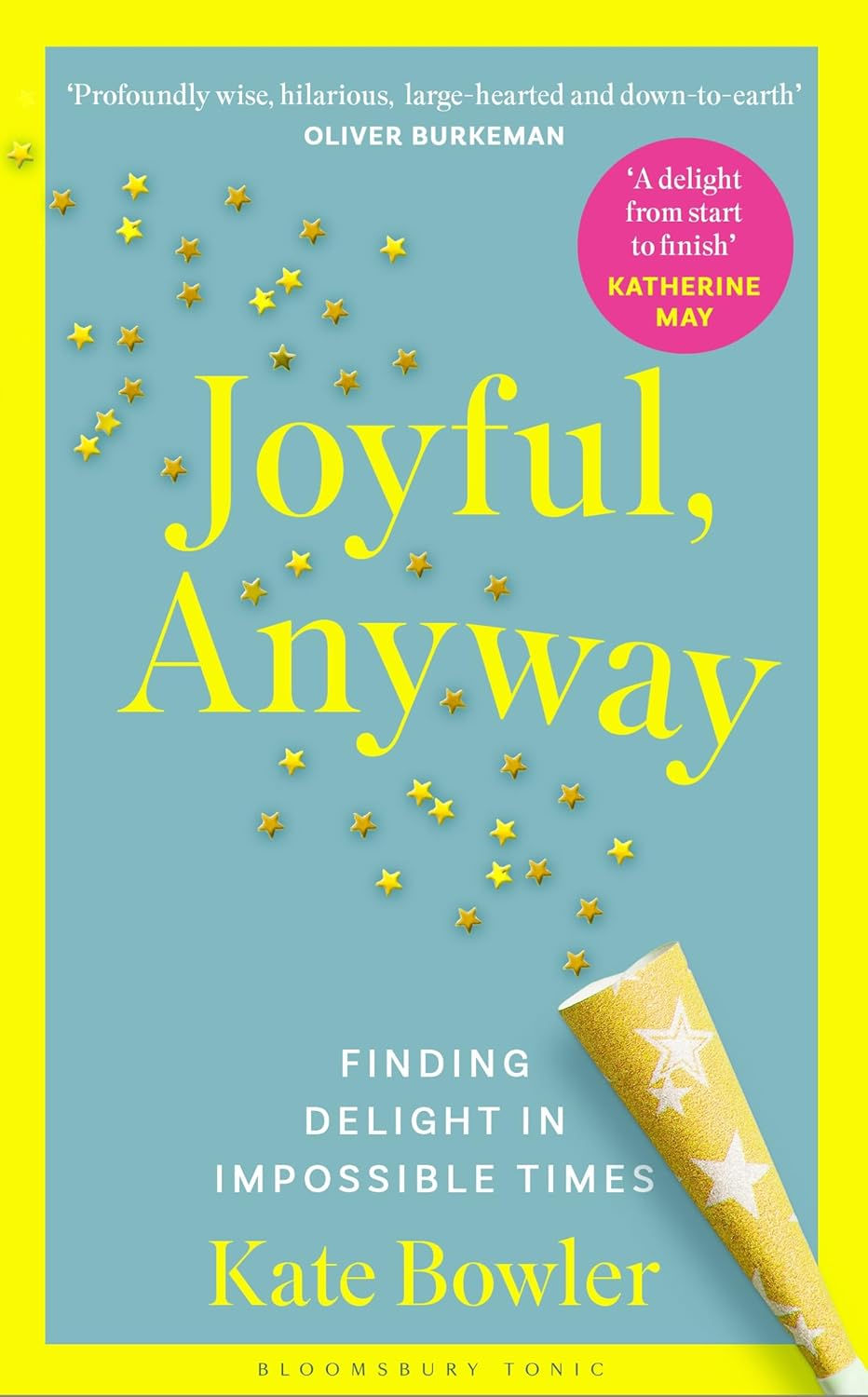
Kate Bowler is a divinity professor at Duke who, at thirty-five, was diagnosed with stage four colon cancer. What she has written in the years since — about suffering, meaning, and the strange, stubborn persistence of joy — has built her one of the most devoted audiences in contemporary nonfiction. Joyful Anyway, arriving in April 2026, is her most personal and perhaps most powerful work yet.
The book is not a survival story in the conventional sense. Bowler is not interested in triumphalism or easy consolation. What she offers instead is something rarer: an honest, theologically grounded, emotionally courageous exploration of what it means to find light in a life that includes real darkness — not in spite of the darkness, but within it.
Bowler writes with a precision and honesty that makes every sentence feel earned. She does not tell you that everything happens for a reason. She does not promise that joy is a reward for the right attitude. What she does is bear witness — to her own experience, to the experiences of others who have faced profound loss — and in that bearing witness, creates something that feels like a hand reaching through the page.
Who this book is for
For anyone navigating grief, illness, loss, or the simple, heavy uncertainty of a life that has not gone as planned. Which is to say: for everyone.
Key Principles from Where Joy Lives
Write one paragraph today about your life as it actually is right now — not the version you're working toward, the actual present tense — then read it back and underline one sentence that is, honestly, enough
Think of one person in your life who is going through something genuinely hard — write them a message this week that simply names what is difficult without reframing it, fixing it, or finding the silver lining — just witness it
Start a "what was still good" note on your phone — every evening this week, add one thing that was genuinely present and good, however small — not impressive, not meaningful, just real
The next time someone in your life is suffering, sit with them for ten minutes without offering a single piece of advice, reframe, or encouraging perspective — just be present and say "this is hard" — notice what that gives them
Write down three things you've been waiting to enjoy until some future condition is met — "when the project is done," "when I've lost the weight," "when things calm down" — and do one of them this week in its imperfect present-tense form
Find the Kate Bowler phrase "you don't have to earn your life" and put it somewhere you'll see it on a day when you feel behind — your phone lock screen, your desk, anywhere — and let it do its work
This week, have one conversation with someone you care about that starts with "I don't actually have it figured out" — and means it
At the end of this month, write one page about something you have right now that you know, concretely, will not always be there — write it as a record, not a warning
Chapter-by-chapter summary of Joyful Anyway
Part One: The End of Easy Answers
Bowler opens by dismantling the cultural scripts that we reach for when life breaks — the language of silver linings, of lessons learned, of everything happening for a reason. She is not cruel about it. She understands why these scripts exist: they are how we protect ourselves and each other from the rawness of suffering. But she argues, with characteristic precision, that they ultimately fail the people they're meant to comfort, because they implicitly require that the person suffering justify their pain or redeem it with growth. And pain, she insists, doesn't owe anyone a lesson.
We are a culture terrified of suffering without a narrative arc. But sometimes the most honest thing you can say is: this is just hard.
Practical exercise: Think of someone in your life who is currently going through something genuinely difficult. Notice the impulse to offer a reframe, a silver lining, or a lesson. Try instead to write them a note — or have a conversation — that simply names what is hard, without fixing it. That act of witness is often more valuable than any comfort.
Part Two: Where Joy Lives
The middle section is the book's heart. Bowler explores what joy actually is, stripped of its cultural baggage — not happiness, not optimism, not the absence of pain, but something that can coexist with all of those things and is, in some ways, deepened by them. She draws on theological and philosophical traditions — from Julian of Norwich to contemporary psychology — to build a portrait of joy as a practice, a posture, a way of attending to what is still present even when much has been lost.
Joy is not the reward you get when things go right. It's what you find when you're honest about what remains.
Practical exercise: At the end of each day for two weeks, write down one thing that was genuinely good — not impressive, not significant, just good. A conversation, a meal, a moment of light. The practice of noticing trains the capacity to find.
Part Three: The Grammar of Enough
The final section explores what Bowler calls "the grammar of enough" — the art of building a life that is meaningful not because it fulfils every aspiration but because it is fully inhabited. She writes about mortality not with resignation but with a kind of alert tenderness, the particular quality of attention that comes from knowing, more concretely than most, that time is finite.
You don't have to earn your life. You just have to live it.
Practical exercise: Write a paragraph about your life as it currently is — not as you hope it will be, not as you wish it were, but as it actually is right now. Read it back. Find one sentence in it that is, honestly, enough.
Anxietyland by Gemma Correll Summary — The 2026 Illustrated Guide That Makes Anxiety Visible
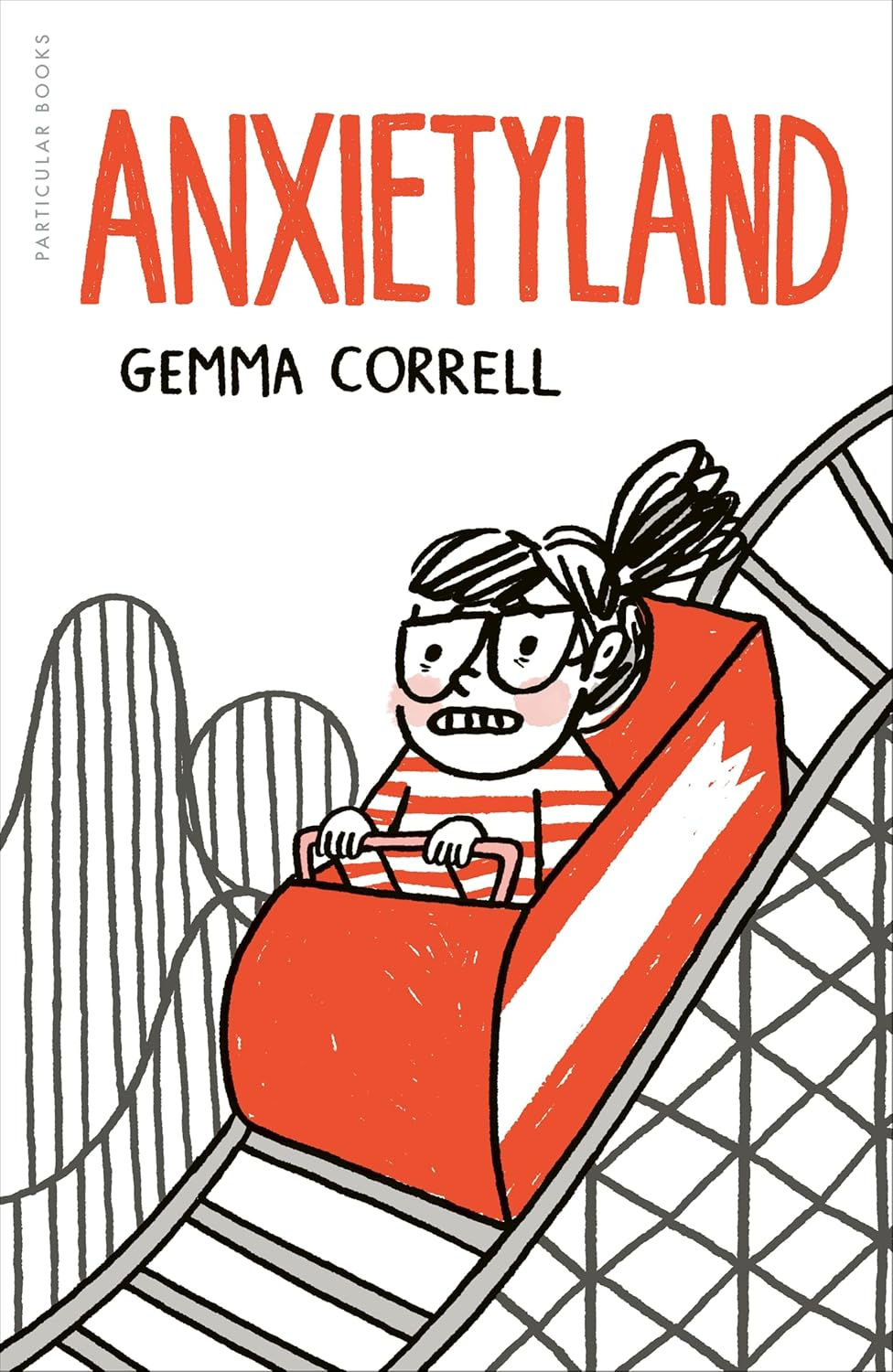
Gemma Correll is a cartoonist whose visual essays on anxiety, introversion, and the absurdity of modern life have amassed a large following online. Anxietyland, arriving in April 2026, is her most sustained and ambitious work — a graphic guide to the inner landscape of anxiety that manages to be simultaneously hilarious and profoundly validating.
The book works on multiple levels. On the surface, it is funny in the way that only deeply honest work can be — the recognition humour of seeing your own most embarrassing neuroses rendered in loving, absurd detail. Underneath the laughter is a serious project: to destigmatise anxiety by making it visible, familiar, and shared.
Correll draws on her own experience with anxiety and broader psychological research to map the territory of anxious experience — the rumination spirals, the catastrophic projections, the social anxiety rehearsals, the 3am certainties that everything is ruined. She renders each of these experiences with an accuracy that feels like diagnosis, and then — crucially — finds the comedy in them without minimising their weight.
Who this book is for
For anyone who lives with anxiety — and for the people who love them and want to understand. Also, genuinely, for everyone — because Correll's work has a way of revealing the anxious undercurrent in experiences most people thought they were having alone.
Key Principles from Anxietyland
Give your inner critic a name — a genuinely ridiculous one — right now, before you finish reading this sentence — then notice how much less authority "Gerald" has over your decisions than "the voice in my head"
The next time anxiety starts to build, narrate it out loud in the third person: "she is catastrophising about the presentation again, the presentation is not a meteor" — do this even if it feels strange, especially if it feels strange
Draw a basic map of your personal Anxietyland this week — it does not need to be good art — label at least three landmarks that you regularly visit and give each one a name — the act of mapping creates distance
Identify your most frequent anxiety loop — the specific thought spiral you run most often — and write the whole thing out from start to finish on paper, including the catastrophic ending — seeing it fully often reduces its power immediately
Set a "catastrophe audit" for the next thirty days — every time you predict a catastrophic outcome, write it down with a date — at the end of the month, review how many came true and how many were false alarms
The next time you're doing a mental social autopsy — replaying a conversation looking for everything you did wrong — set a five-minute timer, let yourself do it fully, and when the timer goes off, close it and move on — give the process a container
Pick one anxiety you've been keeping private and tell one trusted person about it this week, framed as lightly and honestly as Correll would — not as a crisis, just as a thing that's happening — notice whether naming it out loud changes its weight
Find one thing about your anxiety that is genuinely, specifically funny — not dismissive, not minimising, actually funny — and write it down — then the next time that anxiety appears, say the funny thing to yourself first
Chapter-by-chapter summary of Anxietyland
Part One: Welcome to Anxietyland
The opening section maps the territory. Correll introduces the major landmarks of the anxious inner landscape: the Rumination Spiral, the Catastrophe Factory, the Social Autopsy Theatre (the place where you replay every social interaction you've ever had and identify every possible way you might have come across badly). She renders each of these with the specificity that is Correll's great gift — not abstract psychological concepts but the actual, specific, ridiculous texture of how anxiety feels from the inside.
Anxiety is not irrational. It is incredibly rational, applied to the wrong things, at the wrong times, with excessive thoroughness.
Practical exercise: Draw your own map of Anxietyland — even if you can't draw. Label the landmarks that are most familiar to you. The act of externalising the landscape, giving it a name and a shape, begins to create the observer distance that reduces its power.
Part Two: The Residents
The middle section profiles the recurring characters of anxious experience: the Inner Critic, the Catastrophist, the Social Comparator, the Imposter. Correll's treatment of each is both affectionate and clear-eyed. She understands that these characters exist for reasons — they evolved as protective mechanisms — and she doesn't ask readers to eliminate them but to understand them well enough to not be entirely at their mercy.
The Inner Critic isn't trying to destroy you. It's trying to protect you from a world it's convinced is going to destroy you first. It's just terrible at its job.
Practical exercise: Name your inner critic. Give it a ridiculous name. Notice how much less authority a voice called "Gerald" has over your decisions than a voice called "the truth."
Part Three: Finding the Exit (Sort Of)
The final section is characteristically honest: Correll does not promise a cure. She offers something more useful — a set of practices for living more lightly within the landscape of anxiety, for reducing its grip without pretending it will disappear. The section on the relationship between humour and anxiety is particularly valuable, examining the research on how laughter actually changes the physiological signature of anxious experience and why finding something funny about your neuroses is not a trivialisation but a genuine therapeutic tool.
The goal is not to leave Anxietyland. The goal is to stop letting it run the tour.
Practical exercise: The next time you notice anxiety building, narrate it to yourself in the third person, out loud if possible: "She is catastrophising about the email again. The email is not a meteor." The cognitive distance of third-person narration has documented effects on emotional intensity. And it's genuinely funny.
Success: Adam Grant's Spring 2026 Book Picks on Achievement and Performance
Inside the Box by David Epstein Summary — The Best 2026 Book on Creativity and Constraints
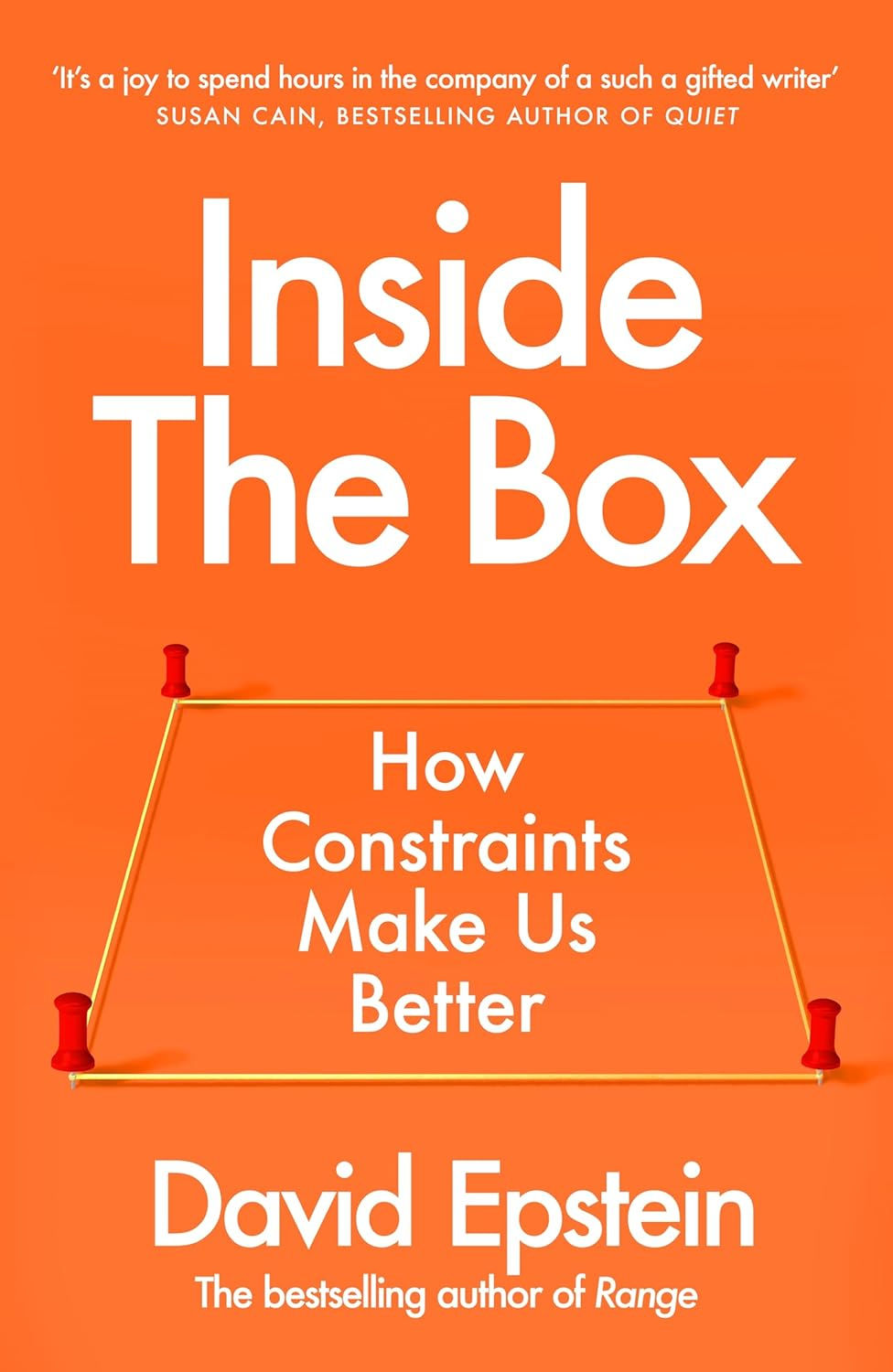
David Epstein, whose previous work on the science of learning and expertise reshaped conversations about specialisation and generalism, arrives in May 2026 with Inside the Box — a counterintuitive and deeply researched argument about the relationship between constraints and creativity. This is already one of the most anticipated spring 2026 book releases in the nonfiction space, and it delivers.
The book's thesis pushes against one of the most persistent myths of the innovation economy: that freedom unlocks potential. Epstein draws on a rich body of cognitive science and real-world case studies to demonstrate that the opposite is often true. Constraints — the right constraints, intelligently designed — focus attention, reduce decision fatigue, and force the kind of lateral thinking that unconstrained environments rarely produce.
Epstein takes us through the history of creative breakthroughs across science, art, engineering, and sport, and finds a consistent pattern: the most transformative innovations frequently emerged not in spite of limitations, but because of them. The sonnet is a more demanding form than free verse. The racing driver who masters a slower car often outperforms peers on the faster one. Dr. Seuss wrote one of the most celebrated children's books in history after accepting a bet to use no more than fifty words. The constraint was not the obstacle. It was the engine.
The book offers a practical framework for identifying which constraints are generative and which are merely stifling — a distinction that turns out to be crucial and is almost never discussed in the endless literature on productivity and creative output.
Who this book is for
Essential for entrepreneurs, product designers, educators, athletes, creative professionals, and anyone who has believed that more freedom should produce better results but hasn't been able to make it work.
Key Principles from Inside the Box
Take the project on your to-do list that has been stuck the longest and impose three constraints on it right now: you have 90 minutes to make meaningful progress, you can use only resources you already have, and your output must fit on one page
Book a 90-minute "constraint session" with your team this month — give them a specific, narrow problem, tell them the solution must use no new budget, and set a hard stop — debrief on what emerged versus your normal ideation process
The next time you feel creatively blocked, resist the instinct to ask for more time, more budget, or more freedom — instead, ask what one additional constraint would force you to think differently
Pick one skill you're trying to develop and deliberately practise it under a constraint it doesn't normally face — write with a word limit, present without slides, code without your usual libraries — do this once a week for a month
Before your next project kickoff, write down the constraints that already exist — time, budget, team size, scope — and reframe each one explicitly as a creative tool rather than a limitation before you begin
Identify one "stifling constraint" in your current work — a process, rule, or limitation that reduces options without generating any compensatory creative pressure — and write a one-paragraph proposal for redesigning it into something that actually focuses rather than just restricts
Find one historical example of a creative breakthrough that came directly from a constraint — Dr Seuss and fifty words, Bach and counterpoint rules, Murakami writing in his second language — and keep it somewhere visible when your own work feels hemmed in
At the end of each week for the next month, write down the single best idea you had — then check whether it came from a constrained situation or an open-ended one — track the pattern over four weeks
Chapter-by-chapter summary of Inside the Box
Part One: The Freedom Myth
The opening section dismantles what Epstein calls the "blank canvas fallacy" — the widespread cultural belief that creative potential is maximised when options are unlimited. He draws on cognitive science showing that the human brain, when confronted with infinite choice, defaults to familiar patterns rather than generative exploration. Constraints, by contrast, force the brain beyond its default tendencies and into the higher-effort thinking where genuinely novel solutions emerge.
The chapter's most striking case study is General Magic — a Silicon Valley startup in the early 1990s that assembled an extraordinary roster of talent, gave them essentially unlimited resources and time, and told them to build the future of computing. They had everything: funding, genius, freedom. They failed spectacularly. Meanwhile, the teams working under the tightest constraints — fixed budgets, hard deadlines, narrow briefs — produced the breakthroughs that actually shipped.
Total freedom is the enemy of creativity. Constraint is its companion.
Practical exercise: Pick one project you're currently working on that feels stuck. Deliberately impose three constraints — a time limit, a resource limit, and a scope limit. Work within those constraints for one week and document what emerges. The results will likely surprise you.
Part Two: The Constraint Taxonomy
The middle section is the book's most practically valuable. Epstein distinguishes between what he calls "productive constraints" — limits that focus attention and expand creative possibility — and "stifling constraints" — limits that simply reduce options without generating compensatory pressure toward innovation. The taxonomy is built from research across domains and includes a diagnostic framework for identifying which type of constraint you're dealing with.
He examines the role of constraints in music composition (Bach's formal structures produced arguably the most complex and original music in Western history), in sport (athletes who learn in constrained environments often develop more adaptive movement patterns than those given unlimited practice time and space), and in organisational innovation (the most celebrated product breakthroughs at companies including Apple, Google, and IDEO came from deliberately constrained briefs, not open-ended ideation).
The question is never whether to have constraints. The question is whether you're choosing the right ones.
Practical exercise: Audit the constraints currently operating in your professional life. For each, categorise it as productive (it pushes you toward better solutions) or stifling (it simply limits without generating compensatory pressure). Then ask: which stifling constraints can be redesigned into productive ones?
Part Three: Designing for Creative Constraint
The final section moves from analysis to application. Epstein offers a set of design principles for building constraint-based environments — for teams, for personal creative practice, and for institutional innovation processes. He is particularly strong on the temporal dimension of constraint: the finding that time limits, when set at the right level of tightness, consistently outperform both open-ended timelines and impossibly short deadlines in producing creative output.
You don't think outside the box. You think at its edges. That's where the ideas live.
Practical exercise: Set a "creative constraint session" for your team: a 90-minute block with a narrowly defined problem, a strict word or slide limit for proposed solutions, and a rule that no solution can use any resource you don't already have. Run it once a month for three months and measure the quality of output against your unconstrained ideation sessions.
The Power of Beliefs by Shawn Achor Summary — The 2026 Science of Mindset and Success

Shawn Achor has spent twenty years researching the relationship between mindset, happiness, and success. In The Power of Beliefs, arriving in May 2026, he synthesises the most recent advances in positive psychology to make his most ambitious argument yet: that our beliefs are not merely reflections of our circumstances but active architects of our outcomes.
This is not a book about positive thinking in the naive sense. Achor is clear that optimism divorced from reality is a liability, not an asset. What he documents instead is the science of "calibrated belief" — the specific mental orientations that predict high performance, resilience, and wellbeing across domains, and that can be cultivated deliberately rather than inherited by disposition.
The book is structured around what Achor identifies as the core beliefs that most reliably predict exceptional outcomes: beliefs about agency, connection, growth, meaning, and contribution. For each, he presents the research base, the mechanisms through which the belief operates neurologically and psychologically, and practical strategies for cultivating it — even in people whose default orientation runs in the opposite direction.
Who this book is for
For coaches, leaders, educators, therapists, athletes, and anyone who has felt held back by a story they didn't choose and couldn't quite escape.
Key Principles from The Power of Beliefs
Write down your three most active limiting beliefs right now — not the ones you know you should challenge, the ones that actually stopped you from doing something in the last seven days
For each limiting belief, find one specific piece of evidence from your own past that directly contradicts it — not aspirational evidence, actual evidence — and write it in the present tense: "I am someone who has already done X"
Set a phone reminder for 8pm every day this week that asks one question: "what did I do today that I chose and that mattered?" — answer it in two sentences, every day, for seven days
Identify the one person in your professional life who most consistently makes you feel that your work has impact — schedule thirty minutes with them this month and tell them specifically what that does for your performance
The next time you face a setback, give yourself exactly twenty-four hours to feel it fully — then on day two, write down one specific action you can take that demonstrates agency, however small, and do it before noon
Pick one area of your work where you currently hold a "fixed" belief — "I'm not good at presenting," "I don't have a head for numbers" — and design one small experiment this month that tests whether the belief is actually true or just familiar
Write a "beliefs inventory" — five things you believe strongly about your own capacity — and for each one, write the answer to: when did I last seriously test this? Set a calendar reminder to revisit it in ninety days
Identify one person in your team or life whose belief in their own potential appears to be limiting their performance — have one specific, honest conversation with them this month that offers evidence they might not be seeing
Chapter-by-chapter summary of The Power of Beliefs
Part One: The Architecture of Belief
Achor opens by establishing the neurological mechanism through which beliefs shape outcomes. Drawing on research in positive psychology, neuroscience, and behavioural economics, he demonstrates that beliefs function as perceptual filters — they determine which information we notice, which we discount, and which we act on. Two people with identical objective circumstances but different belief systems will, over time, produce meaningfully different outcomes. Not because of luck or talent, but because of what they're looking for and what they find.
Your beliefs don't describe your reality. They construct it.
Practical exercise: Write down the three beliefs about yourself that most frequently limit your actions. For each, identify one piece of evidence from your own experience that contradicts the belief. Evidence that you already have is more persuasive than evidence you're promised you'll one day find.
Part Two: The Five Belief Levers
The middle section examines each of the five core beliefs in turn. The belief in agency — the conviction that your actions genuinely shape your outcomes — is perhaps the most foundational. Achor presents research showing that even modest interventions that strengthen a sense of personal agency produce measurable improvements in performance, resilience, and physical health. The belief in connection — the sense that you belong to something larger than yourself — is the most protective against burnout and disengagement. The belief in growth is the one most familiar from Carol Dweck's work, but Achor extends it with more recent neuroscience about how belief in change actually changes the brain.
The most powerful predictor of where you'll be in five years is not what you know. It's what you believe is possible.
Practical exercise: Choose one of the five belief levers — agency, connection, growth, meaning, or contribution — and spend one week actively looking for evidence that it applies to your life. Evidence you seek and find has a disproportionate effect on the beliefs you hold.
Part Three: Cultivating Belief Under Pressure
The final section addresses the question of sustainability: how do you maintain growth-oriented beliefs when circumstances are genuinely difficult? Achor is honest here in a way that distinguishes the book from more superficial treatments of positive psychology. He does not promise that belief alone is sufficient. He argues instead that in the presence of adversity, beliefs determine which resources you mobilise — and that the people who navigate difficulty best are not those who feel no fear, but those who hold beliefs about their own capacity that are resistant to the corrosive effect of failure.
Resilience is not the absence of difficulty. It is the presence of a belief system that can metabolise it.
Practical exercise: Identify the last significant setback you experienced professionally. Write down what you believed about yourself, your capacity, and your future in the week after it happened. Then write down what you believe now. The distance between those two accounts is a map of your resilience.
Why We Talk Funny by Valerie Fridland Summary — The Spring 2026 Linguistics Book Changing How We Think About Accents

Valerie Fridland, a linguist at the University of Nevada, arrives in April 2026 with one of the year's most unexpectedly compelling books. Why We Talk Funny explores the science of accent, dialect, and linguistic variation — and discovers that the way we speak is not merely a quirk of geography. It is a social signal, a tribal marker, and — whether we like it or not — a predictor of how others judge our intelligence, competence, and character.
Fridland is a rigorous scientist and a gifted storyteller. She uses both skills to walk readers through the mechanics of how accents form, why they persist across generations, and why they shift. The book is particularly compelling on the social psychology of accent perception — the research showing how systematically and unconsciously people make judgements about speakers based on the way they sound, often without any awareness that they're doing it.
But Why We Talk Funny is not a book that leaves you feeling resigned. Fridland also examines the ways in which linguistic diversity enriches culture, preserves history, and signals authenticity — and she makes a powerful case for resisting the homogenisation of speech in professional and educational contexts.
Who this book is for
Linguists, communication coaches, HR professionals, educators, recruiters, and anyone who has ever been told — explicitly or implicitly — that the way they speak is a problem.
Key Principles from Why We Talk Funny
Record yourself in a professional setting this week — a meeting, a presentation, a call — and listen back once, not to critique your content but to notice your relationship to the way you sound
In your next round of hiring or promotion decisions, write down your assessment of each candidate before you note anything about their accent, speech pattern, or communication style — then check whether your written assessment shifted after you heard them speak
Add "linguistic inclusion" as a standing agenda item in your next diversity and inclusion review — prepare one specific question about how accent and dialect may be affecting whose ideas are heard and actioned in your organisation
Find one speaker, podcast, or public figure whose accent is markedly different from your own and whose ideas you find genuinely valuable — listen to them for thirty minutes a week for the next month and notice whether the accent becomes less distracting over time
The next time you feel the impulse to suggest someone "work on their communication style," pause and write down specifically what the concern is — then ask whether the issue is clarity, or familiarity
If you're currently working with a communication coach or considering it, ask them directly: "are you helping me communicate more clearly, or are you helping me sound more like a certain kind of professional?" — the answer matters
In your next team offsite or workshop, introduce one exercise that explicitly celebrates different communication styles — regional expressions, different rhetorical traditions, varied ways of constructing an argument — and frame it as a cognitive resource, not a curiosity
This week, pay deliberate attention in at least two conversations to whether the accent of the speaker is affecting how seriously you're weighing their ideas — write down what you notice at the end of each day
Chapter-by-chapter summary of Why We Talk Funny
Part One: How Accents Are Born
The opening section takes readers inside the mechanics of accent formation. Fridland explains that accents are not random. They are the product of the phonological rules of the communities in which we learn to speak, laid down in early childhood during the same sensitive periods that Suskind describes in Human Raised. Once established, they are extraordinarily persistent — not because they're fixed neurologically, but because they're deeply tied to identity. To change how you sound, at a deep level, is to change who you signal yourself to be.
An accent is not an error. It is a record of where you come from and who you belong to.
Practical exercise: Listen to a recording of yourself speaking in a professional context. Now listen to a recording of yourself speaking with close friends or family. Notice the differences. What do those differences tell you about which version of yourself you present in which rooms — and whether that's a choice you're making consciously?
Part Two: The Judgement Machine
The book's most uncomfortable and important section examines the research on accent-based discrimination. Fridland presents study after study showing that listeners form rapid, confident judgements about a speaker's intelligence, trustworthiness, competence, and social status based almost entirely on accent — and that these judgements persist even when explicitly contradicted by the speaker's actual qualifications or content.
The implications for hiring, promotion, and professional credibility are significant and almost entirely unaddressed by mainstream diversity and inclusion frameworks, which tend to focus on visible identity markers while overlooking the auditory ones.
We've made it socially unacceptable to discriminate based on what people look like. We haven't had the same conversation about how they sound.
Practical exercise: In your next series of professional meetings, consciously notice your own reactions to the accents of the speakers. Not to judge yourself for having them — reactions are automatic — but to identify which reactions are influencing your assessments of the person's ideas. The awareness alone begins to create choice.
Part Three: In Defence of Linguistic Diversity
The final section makes an affirmative case for the value of accent diversity — not just as an equity issue but as a cognitive and cultural one. Fridland draws on research showing that linguistically diverse environments produce richer conceptual landscapes, more creative problem-solving, and stronger collective intelligence. The push toward accent neutrality in professional settings is not just socially costly. It is intellectually impoverishing.
Every accent that disappears takes a way of seeing with it.
Practical exercise: Find one speaker, podcast, or public figure whose accent is markedly different from your own and whose ideas you find genuinely challenging and interesting. Listen to them regularly for a month. Notice whether your comfort with the accent changes — and whether that changes how you hear the ideas.
A Better Future: The Spring 2026 Book Releases Asking the Hardest Questions
Human Raised by Dana Suskind Summary — The Essential 2026 Book on Raising Children in the AI Age

Dana Suskind is a pediatric surgeon who has spent her career at the intersection of medicine, neuroscience, and childhood development. Human Raised is one of the most urgently needed books of this decade — a rigorous, compassionate interrogation of what it means to raise children in a world increasingly mediated by artificial intelligence.
The book's central thesis is deceptively simple: the most powerful developmental tool a child will ever have is not a device, an app, or an algorithm. It is a human relationship. Suskind draws on her landmark work with the Thirty Million Words initiative to argue that language — specifically the quality, quantity, and emotional context of human speech directed at children — is the primary architect of the developing brain. What makes Human Raised so striking is that it doesn't frame AI as the enemy. It asks a more uncomfortable question: are we, as parents and caregivers, outsourcing the irreplaceable?
The book opens by grounding readers in the neuroscience of sensitive periods — the neurological windows in early childhood when the brain is most receptive to language, connection, and stimulation. These windows don't wait. And they cannot be reopened by a chatbot, no matter how sophisticated. Suskind walks through the longitudinal research showing how caregiver responsiveness — the simple act of noticing a child's cue and responding with warmth and language — produces lifelong differences in cognitive ability, emotional regulation, and social competence.
What follows is not a polemic against technology. Suskind is too rigorous for that. Instead, she examines the mechanisms by which screen time and AI interaction, when substituted for human connection, fail to provide the contingent, emotionally attuned engagement that a developing nervous system requires. AI can respond, but it cannot attune. It can speak, but it cannot truly listen in the way that shapes a child's sense of self.
The book's middle section turns to institutional systems — schools, healthcare, childcare — and asks how we design environments that protect children's developmental needs while integrating technology responsibly. Suskind is particularly compelling on the role of socioeconomic inequality here: the children most likely to be raised in AI-mediated environments are often those who can least afford the developmental costs.
The final section is a call to action, both personal and political. Suskind wants parents to feel empowered, not shamed. She offers a framework for mindful technology integration that centres the child's developmental needs without pretending that screens can simply be eliminated from modern life.
Human Raised is a love letter to human connection — and a quietly urgent warning that we cannot afford to take it for granted.
Who this book is for
Essential reading for parents of young children, early childhood educators, paediatricians, policymakers working in education or technology, and anyone thinking seriously about what raising children in the age of AI actually demands of us.
Key Principles from Human Raised
When your child makes any sound, gesture, or facial expression, stop what you're doing and respond with words — do this at least ten times a day as a conscious practice, not just when it's convenient
Before handing your child a device, say out loud what human interaction it's replacing — make the substitution visible so it becomes a choice rather than a reflex
Set a daily "narration window" — twenty minutes where you describe everything you're doing in real time, as if your child is your co-pilot: "now we're washing the apples, I can feel how cold the water is"
Once a week, sit on the floor with your child and no phone in the room for thirty minutes — no agenda, no structured play, just following their lead and responding to what they do
Write down three specific moments this week where a screen replaced a potential conversation — review it on Sunday and ask whether the pattern is intentional
At the next parents' evening or school meeting, ask one direct question about how the school measures caregiver-child interaction quality, not just screen time limits
Time yourself during a typical evening — set a stopwatch for every minute your child spends in genuine back-and-forth conversation versus passive screen time — the number will be instructive
Send one message this week to another parent, a nursery worker, or a school governor sharing one specific finding from the book — institutional change starts with individual conversations
Chapter-by-chapter summary of Human Raised
Part One: The Architecture of Early Childhood
The opening section grounds readers in the neuroscience of early development with an accessibility that never sacrifices rigour. Suskind begins with a clinical story — a child who arrived in her practice with profound hearing loss — and uses this as a portal into the broader science of language acquisition. What she discovered through her work on cochlear implantation was that the device itself was only the beginning. The outcomes for children who received implants varied dramatically, and the variable that explained most of that variance was not the surgery. It was the richness of the language environment that followed.
From here, the chapter unfolds into an exploration of the brain's sensitive periods. Suskind explains that the architecture of a child's language system is not determined by genetics alone; it is built, conversation by conversation, through what she calls "serve and return" interactions. When a baby babbles and a caregiver responds with warmth and words, a synapse is strengthened. When that response is replaced by a screen — one that responds without attunement — the architecture changes in ways that matter for decades.
The key learning is transformative in its simplicity: the most powerful developmental intervention available to any parent is free, requires no training, and is available in every waking moment. It is paying attention and talking back.
Every interaction is a lesson, every response a building block.
Practical exercise: For one week, commit to narrating your daily activities to your child in real time — not for entertainment, but to create a rich stream of contingent, responsive language. Notice when you reach for a device instead, and ask yourself honestly what that substitution costs.
Part Two: What AI Cannot Give
The second section addresses the mechanism question directly. What, specifically, does AI-mediated interaction fail to provide that human interaction does? Suskind's answer is precise: contingent attunement — the dynamic, second-by-second responsiveness to a child's emotional state that shapes the nervous system's development. She draws on research showing that even high-quality educational technology produces significantly weaker developmental outcomes than equivalent human interaction time, not because the content is inferior but because the relational quality is categorically different.
This section is also where Suskind takes on what she calls the "substitution fallacy" — the assumption that because a child is engaging and learning from a device, the interaction is developmentally equivalent to human engagement. It is not. The brain, she argues, is a social organ first. It learns within relationships. Technology can supplement that learning beautifully. It cannot substitute for it.
The question is never whether technology is good or bad. The question is what it costs when it replaces something irreplaceable.
Practical exercise: Audit one typical evening at home. How many minutes did your child spend in contingent human interaction — conversation where their responses genuinely shaped what you said next — versus passive or semi-interactive screen time? The honest answer is often the most useful one.
Part Three: Designing Environments That Protect Children
The final section moves from the individual to the institutional. Suskind's argument here is structural: the challenge of raising children in the AI age is not solely a parenting problem. It is a design problem. Schools, childcare settings, and healthcare environments can all be structured to either protect or erode the developmental conditions children need. She offers a framework for what she calls "human-centred design" in educational and care settings — one that treats caregiver responsiveness as a measurable, optimisable outcome rather than an incidental byproduct of good intentions.
The chapter ends with a call that is both personal and political: to hold technology companies, policymakers, and institutions accountable to the same developmental science that parents are increasingly expected to internalise on their own.
We don't leave children's physical safety to chance. We shouldn't leave their developmental safety to chance either.
Practical exercise: Write down three specific moments today where you replaced a potential human interaction with a technology interaction — for your child, or for yourself. For each one, ask: was the substitution necessary, or habitual?
Incorruptible by Eric Ries Summary — The 2026 Book on Why Good Companies Go Bad

Eric Ries, the entrepreneur and author who reshaped how Silicon Valley thinks about building companies, arrives in May 2026 with Incorruptible — a book that tackles one of the most persistent and painful questions in organisational life: why do good people and good companies so reliably end up doing bad things?
Ries argues that corruption is not primarily a character problem. It is a systems problem. The individuals who perpetuate unethical behaviour in organisations are rarely cartoon villains. They are, more often, ordinary people operating within systems that reward short-term outcomes, obscure individual responsibility, and punish dissent. Incorruptible is a road map for designing those systems differently.
The book draws on case studies from technology, finance, healthcare, and government, tracing the structural conditions that create ethical collapse. Ries is particularly interested in the role of measurement — the way organisations quantify success in ways that inadvertently incentivise misconduct. When the only metric that matters is the quarterly number, ethical shortcuts become mathematically rational.
What makes the book distinctive is its refusal to stop at diagnosis. Ries offers a set of institutional design principles — transparency mechanisms, accountability structures, and cultural practices — that create what he calls "integrity gradients": environments where ethical behaviour is easier than unethical behaviour, and where deviation from integrity meets genuine friction.
The final section examines the individual within the system — how to maintain personal integrity when institutional pressures push the other way, and how to be the person who names the problem before it becomes a scandal.
Who this book is for
Essential for founders, executives, board members, compliance professionals, and anyone who has ever watched an organisation they believed in compromise its values and wondered how it happened.
Key Principles from Incorruptible
This week, draw a simple diagram of the three biggest incentive structures in your team or organisation — for each one, write down what behaviour it actually rewards versus what it claims to reward, and put the two lists side by side
In your next team meeting, ask this specific question: "what would someone have to do here to get in trouble for raising a concern?" — listen to what people say and what they don't
Identify one decision your organisation makes regularly that carries high ethical risk and currently has no deliberate friction built in — propose one specific mechanism that would slow it down
Write a one-page integrity audit this weekend — list three things you currently do professionally that you would find uncomfortable defending in public, and next to each one write what it would take to stop
Find the last person in your organisation who raised an uncomfortable concern — find out what happened to them, and be honest about whether that outcome encourages or discourages others from doing the same
Before your next high-stakes professional decision, write down the answer to this question: "who benefits if I make this decision quickly and quietly?" — if the answer makes you uncomfortable, slow down
Pick one meeting per month to open with the question: "is there anything we're currently doing that we'd be embarrassed to see reported?" — put it in the calendar now
Identify one colleague who regularly tells you things you don't want to hear and actively protect their ability to keep doing that — tell them directly that you value it
You can access the full book here.
Chapter-by-chapter summary of Incorruptible
Part One: The Anatomy of Ethical Collapse
Ries opens with a question that most organisational leaders quietly dread: if the people who oversaw the worst corporate failures of the past twenty years were generally intelligent, educated, and — at some earlier point — genuinely well-intentioned, what went wrong? The answer he builds toward is structural. Ethical collapse rarely begins with a single bad decision. It begins with a system that makes small compromises easier than small acts of integrity, and then compounds those compromises over time until the distance between the current state and the founding values is so large that no individual can see how to close it.
The key learning is both humbling and clarifying: the capacity for ethical failure is not a character defect unique to bad actors. It is a predictable output of certain system configurations. Which means it is, in principle, preventable by people who understand those configurations and are willing to change them.
Every institution that has ever collapsed ethically began by telling itself it was different.
Practical exercise: Map the three most significant incentive structures in your organisation. For each, ask: what behaviour does this actually reward, as opposed to what it claims to reward? The gap between those two answers is where ethical risk lives.
Part Two: Designing for Integrity
The middle section is the book's most practically valuable. Ries presents what he calls the "five levers of institutional integrity" — measurement transparency, distributed accountability, protected dissent channels, friction on high-stakes decisions, and leader behaviour as cultural signal. For each lever, he provides both the research base and the implementation framework, drawing on organisations that have successfully embedded these mechanisms and examining the structural reasons why others have failed.
The section on protected dissent is particularly compelling. Ries examines the consistent finding that the people who could have prevented the most damaging institutional failures often knew something was wrong long before the collapse — and were either explicitly silenced or implicitly discouraged from raising the issue. The design implication is clear: organisations that want to survive need to make speaking up structurally safer than staying silent.
Integrity without infrastructure is just intention. And intention alone has never saved a single institution.
Practical exercise: Identify the last three times someone in your organisation raised a concern that made leaders uncomfortable. What happened to those people? The honest answer tells you more about your culture than any values statement on your wall.
Part Three: The Individual Within the System
The final section turns to the personal. Ries acknowledges that not everyone has the authority to redesign the systems they work within. So what do you do when the institution you're part of is moving in a direction that conflicts with your values? He offers a framework that is neither naively optimistic nor defeatist: a set of practices for maintaining personal integrity within imperfect systems, knowing when the cost of complicity has become too high, and how to advocate for structural change from inside.
The most dangerous thing you can do in a corrupt system is convince yourself that your small compromise doesn't matter.
Practical exercise: Write a private integrity audit — one page, honest. What are the three things you currently do in your professional life that you would find uncomfortable to defend publicly? That discomfort is information.
Leave the Lights On by Elizabeth Dunn and Jiaying Zhao Summary — The 2026 Climate Book That Leads With Joy
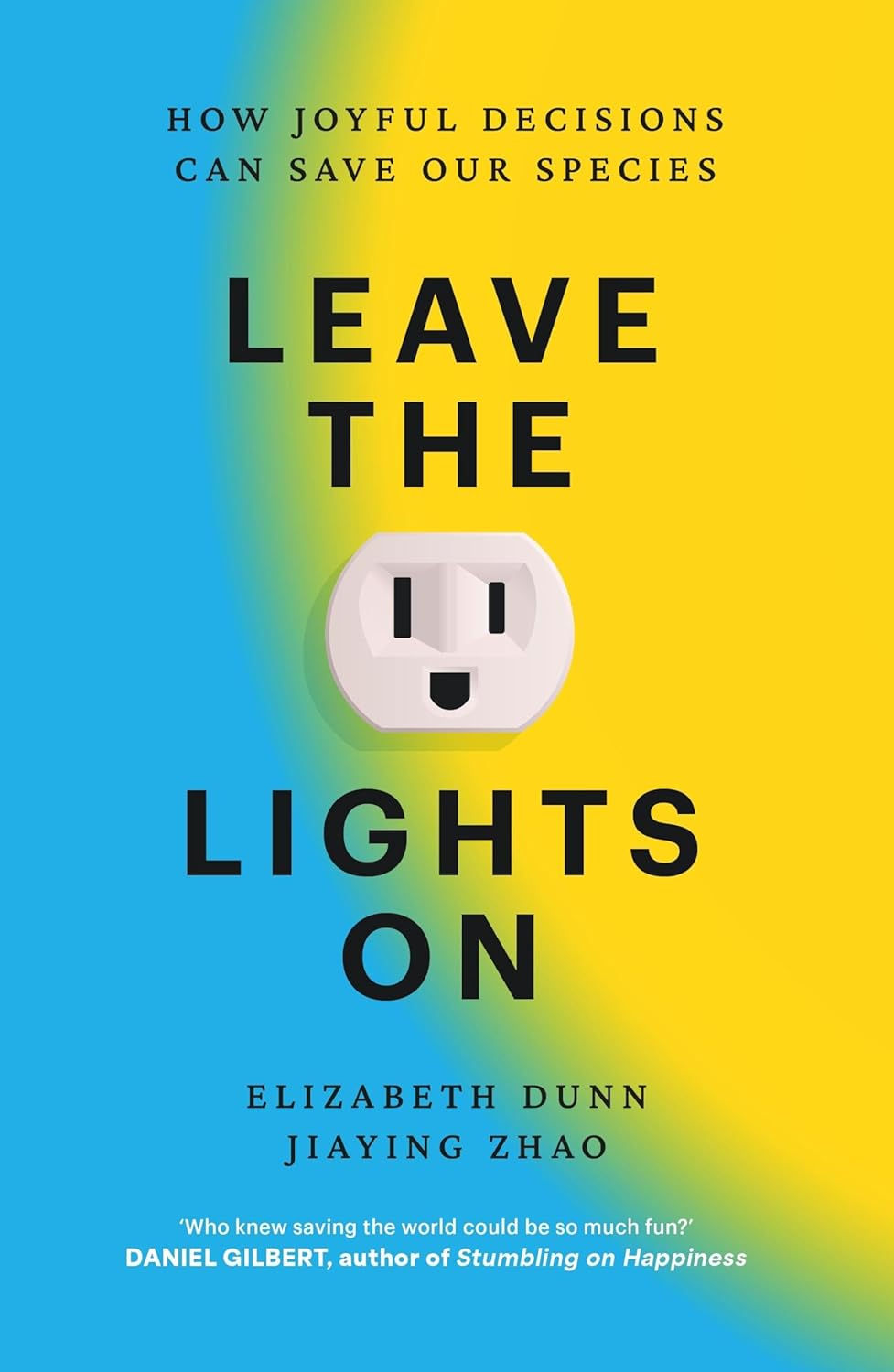
The premise of Leave the Lights On sounds almost provocative in the context of the climate conversation: what if the path to a sustainable future runs through joy, not guilt? Social psychologist Elizabeth Dunn and sustainability expert Jiaying Zhao make exactly that case in this June 2026 release — a book that challenges the dominant emotional register of environmental advocacy and proposes something genuinely different.
Dunn and Zhao argue that the guilt-and-sacrifice framing of climate action has not only failed to produce sufficient behavioural change — it has actively alienated the people who most need to be engaged. Drawing on behavioural science and positive psychology, they propose a reorientation: instead of telling people what they must give up, show them what they stand to gain. People are significantly more likely to adopt sustainable practices when those practices are framed as pleasurable, social, and identity-affirming. The authors offer a masterclass in the science of behaviour change, wrapped in genuinely engaging stories and a warmth that makes the subject feel alive rather than heavy.
Key Principles From Leave The Lights On
Take one sustainable behaviour you've been avoiding and rewrite your internal description of it — instead of "I should reduce meat" try "I'm someone who eats food that tastes good and doesn't cost the planet" — say the new version every time the topic comes up for two weeks
This week, find one local group organised around a sustainable activity — a cycling club, community garden, repair café, or wild swimming group — and attend once with no commitment to return
Identify the three aspects of your current lifestyle you most fear losing to climate constraints — then spend thirty minutes researching whether a sustainable version of each already exists
Replace one habitual purchase this month with a more sustainable alternative that you've genuinely researched for quality — not the cheapest green option, but the best one
The next time you talk to someone about climate or sustainability, consciously remove the word "should" from every sentence — replace it with what you personally find enjoyable, interesting, or worthwhile about the sustainable choice
Set up one environmental behaviour as a social ritual with at least one other person — a weekly walk instead of a drive, a shared vegetable box, anything that ties the sustainable behaviour to a relationship
Track your actual sustainable behaviour for two weeks — not your intentions, your actions — and treat the gap between the two as data, not shame
In any professional communication about sustainability this month, draft the message twice — once in the conventional guilt-and-sacrifice framing, once in the gain-and-enjoyment framing — and send the second one
Who this book is for
For environmental advocates, behavioural scientists, policymakers, sustainability marketers, and anyone who has ever felt paralysed or exhausted by the scale of the climate problem and needed a different way in.
Chapter-by-chapter summary of Leave the Lights On
Part One: Why Guilt Doesn't Work
The opening section builds the evidence base for what Dunn and Zhao call the "guilt gap" — the persistent disconnect between people's awareness of climate change, their genuine concern about it, and their actual behaviour. The research they draw on is counterintuitive: more guilt does not produce more action. Beyond a certain threshold, it produces avoidance, disengagement, and a kind of learned helplessness that is the enemy of the sustained behaviour change the climate requires.
You cannot shame people into saving the planet. But you can invite them.
Practical exercise: Identify one sustainable behaviour you've been meaning to adopt but keep postponing. Reframe it in your own mind — not as a sacrifice, but as something that genuinely improves your daily experience. Then try it for two weeks and notice whether the internal narrative changes.
Part Two: The Science of Joyful Change
The middle section is the book's heart. Dunn and Zhao move through a series of research-backed insights about what actually drives sustainable behaviour at scale: social identity, positive emotion, immediate experiential reward, and community belonging. They examine case studies of interventions — from energy-use competitions between neighbourhoods to restaurant menus redesigned around pleasure rather than restriction — that produced dramatic behaviour change not through obligation but through genuine appeal to what people enjoy.
Sustainable behaviour isn't an act of self-denial. It's an act of self-expression — if we design it that way.
Practical exercise: Find one community or social group in your area organised around a sustainable activity — a cycling group, a community garden, a repair café. Attend once. Notice whether the social experience changes your relationship to the behaviour itself.
Part Three: Designing a Joyful Future
The final section scales the argument from individual behaviour to institutional and policy design. Dunn and Zhao argue that the principles of joyful behaviour change need to be embedded at the level of urban planning, corporate incentive structures, and government policy — not left to individual choice. The chapter is ambitious and occasionally speculative, but it lands with genuine force.
The future we're building doesn't have to be one of less. It can be one of better.
Practical exercise: Write down three aspects of your current lifestyle that you'd genuinely miss if climate constraints eliminated them. Then research whether sustainable alternatives exist that preserve the experience, if not the form. You may find the gap is smaller than you assumed.
Physical Health: The 2026 Books That Will Change How You Live in Your Body
You've Been Pooping All Wrong by Trisha Pasricha Summary — The 2026 Book on Gut Health and the Brain Connection
This is the book you didn't know you needed, written by the doctor you wish you had. Trisha Pasricha is a gastroenterologist at Harvard Medical School, and You've Been Pooping All Wrong, arriving in April 2026, is one of the most genuinely illuminating books on Adam Grant's entire reading list. The title earns its provocation: most of us are, in fact, doing this wrong, in ways that have significant implications for gut health, mental health, and overall wellbeing.
The book explores the gut-brain axis — the bidirectional communication network between the digestive system and the central nervous system — with clarity and genuine excitement. Pasricha makes the case that the gut is not merely a digestive organ. It is a second brain, home to the enteric nervous system, producing a remarkable proportion of the body's serotonin and influencing mood, cognition, and immune function in ways that science is only beginning to fully map.
The book is structured around common misconceptions about digestive health — the habits, diets, and postures we've adopted that work against our biology — and offers a practical, evidence-based guide to working with the body's systems rather than against them.
Who this book is for
For anyone with a digestive system. Which is all of us. Particularly valuable for those dealing with IBS, gut-related mental health issues, dietary confusion, or anyone who has ever been too embarrassed to ask their doctor the questions this book answers plainly.
Key Principles from You've Been Pooping All Wrong
Count the distinct plant foods you ate in the last seven days — write the list right now — if it's under fifteen, add three new plant foods to your shopping list this week with the specific goal of feeding your microbiome, not hitting a macro target
Start a two-week gut-brain journal today — after every main meal, write three words about how you feel two to three hours later — at the end of two weeks, look for the patterns that your body has been trying to show you
Research the squat position for elimination this week — read two articles, watch one video — then decide whether a footstool under your toilet is worth a ten-pound experiment — the biomechanical evidence is stronger than you expect
Identify your single biggest chronic stressor and write down one specific thing you could do this week to reduce it — not eliminate it, reduce it — then do that thing before Friday, knowing that stress management is now a digestive health intervention, not just a mental health one
Look at your diet for the last week and identify what you're eating for your microbiome versus what you're eating for everything else — if the answer is "nothing," add one fermented food and one high-fibre food to this week's meals
Book a GP or gastroenterology appointment if you have a digestive symptom you've been ignoring or been too embarrassed to mention — the embarrassment is not a good enough reason to leave the second brain unexamined
This week, remove the word "gross" from every internal conversation you have about your digestive health — replace it with "clinically interesting" — the stigma is keeping you from information that would improve your quality of life
Audit your antibiotic and medication history with your GP this year — ask specifically about the microbiome impact and what, if anything, you should be doing to restore it — treat this as a standard part of your health review
Chapter-by-chapter summary of You've Been Pooping All Wrong
Part One: The Second Brain
Pasricha opens by introducing readers to the enteric nervous system — the network of approximately 500 million neurons lining the gastrointestinal tract that scientists have begun calling "the second brain." This is not metaphor. The enteric nervous system can operate independently of the central nervous system, processes information autonomously, and communicates upward to the brain via the vagus nerve in ways that meaningfully influence mood, stress response, and cognitive function. The gut produces roughly 95% of the body's serotonin. That number alone reframes the relationship between digestive health and mental wellbeing.
The gut and the brain are in constant conversation. Most of us have never been introduced to our half of the dialogue.
Practical exercise: For one week, keep a simple journal tracking what you eat, when you eat it, and how you feel emotionally in the two to four hours that follow. The data you generate will be imperfect but revealing. Patterns in the gut-brain axis often become visible surprisingly quickly when you start paying attention.
Part Two: What We're Getting Wrong
The middle section is the most practically disruptive part of the book. Pasricha systematically addresses the most common misconceptions about digestive health — from posture during elimination (the research on squatting positions is genuinely surprising) to the timing and composition of meals, the effects of specific dietary trends on the microbiome, and the ways in which stress directly impairs digestive function through the gut-brain connection. None of this is framed with shame. All of it is framed with the clear-eyed pragmatism of a clinician who has had these conversations with patients for years and knows exactly where the gaps in public knowledge are.
We've spent decades optimising our nutrition for macronutrients and calories. We've barely started optimising it for the ecosystem that processes them.
Practical exercise: Research the dietary needs of your gut microbiome — specifically, the role of dietary fibre diversity in maintaining microbial richness. Then count the distinct plant-based foods you ate in the last seven days. The recommended target is thirty different plant foods per week. Most people in Western diets land significantly below ten.
Part Three: Joyful Digestion
The final section earns the book's tone — which is, throughout, one of genuine delight in its subject matter. Pasricha explores what she calls "poophoria" — the physiological pleasure of a healthy, well-functioning digestive system — and makes the case that this aspect of physical wellbeing is treated with unnecessary embarrassment given its central role in health, mood, and quality of life. The chapter is funny, frank, and practically useful in equal measure.
Your gut is not a nuisance. It is a collaborator. Treat it like one.
Practical exercise: Identify one specific change — to diet, posture, stress management, or meal timing — that the book suggests and that you are willing to implement for two weeks. Commit to it in writing. The gut-brain connection responds to consistency more than to dramatic intervention.
The Plunge by Chris Ballard Summary — The 2026 Deep Dive Into the Cold Water Health Craze
Sports journalist Chris Ballard dives — very literally — into one of the most polarising health trends of the past decade in The Plunge, arriving in June 2026. Cold water immersion has moved from the fringes of athletic performance culture to a mainstream obsession, with advocates claiming benefits ranging from reduced inflammation and improved recovery to mood elevation and longevity. Ballard arrives as neither evangelist nor sceptic, and that journalistic neutrality is the book's greatest strength.
The Plunge is structured as a journey — Ballard's own immersion into the cold water community, through wild swimmers, competitive ice swimmers, elite athletes, and ordinary people who have built daily cold water rituals into their lives. Along the way, he reviews the science rigorously, separating the genuinely well-evidenced benefits from the more speculative claims.
The book's most compelling sections explore the psychological dimensions of cold water practice — what it does to the mind's relationship with discomfort, with voluntary hardship, with the physical body. Ballard finds consistent testimony about a kind of mental recalibration that the cold produces: a forced presence that cuts through the noise of modern life with uncommon efficiency.
Who this book is for
For athletes, fitness enthusiasts, the cold-curious, the sceptical, and anyone interested in the psychology of voluntary discomfort and what it teaches us about resilience.
Key Principles from The Plunge
Start tomorrow morning: turn your shower to cold for the last thirty seconds — do this every day for five days before deciding anything about cold water practice — the entry barrier is lower than you think and the data you generate is real
Before adopting any specific cold water protocol, write down in one sentence the exact outcome you're seeking — recovery, mood, resilience, weight loss — then spend twenty minutes reading only the peer-reviewed research on that specific outcome before proceeding
After your first week of cold showers, write down in two sentences how the moment of deliberate choice before the cold feels — that moment is the practice, and articulating it makes it visible
At the end of week three, write down whether anything else in your life has changed in how you respond to discomfort — a difficult conversation you handled differently, a deadline you approached more calmly — the transfer effects are subtle and worth looking for actively
If you're already practising cold water immersion, audit your claimed benefits against the actual evidence this week — write two columns: "I believe this benefit is happening" and "this benefit is well-supported by current research" — be honest about the gap
Find one other person who practises cold water immersion and have one honest conversation about what they genuinely notice versus what they feel they're supposed to notice — the community's internal honesty is often more revealing than its public advocacy
Set a non-negotiable safety rule before your first open water session: never alone, never without checking water temperature and personal health contraindications, always with a re-warming plan — write the rule down before you go
After one month of consistent cold exposure, write a two-paragraph honest assessment of what has actually changed — hold it against what you expected when you started — use the gap as your guide for whether and how to continue
Chapter-by-chapter summary of The Plunge
Part One: Into the Cold
The opening section establishes both the cultural context and the personal stakes. Ballard is an engaging first-person narrator — self-deprecating about his initial resistance, honest about the discomfort, genuinely curious about what drives the people who have made cold water central to their lives. He interviews practitioners ranging from casual wild swimmers to competitive ice swimmers to elite professional athletes whose recovery protocols include daily cold water immersion, and builds a portrait of a practice that is simultaneously ancient, counterintuitive, and oddly compelling.
The cold doesn't care about your reasons for being there. That's precisely why it works.
Practical exercise: Try a 30-second cold shower at the end of your normal shower for five consecutive days. Notice not just the physical sensation but the mental posture it requires — the moment of deliberate choice before the cold water hits. That moment is the practice.
Part Two: What the Science Actually Says
The middle section is the most valuable for readers who want to understand the cold water craze rather than simply participate in it or dismiss it. Ballard reviews the research on cold water immersion's effects across several domains: acute inflammation (strong evidence), delayed onset muscle soreness (good evidence with caveats), mood elevation (strong evidence for acute effects, less clear for long-term), and longevity claims (largely speculative at present). He is scrupulous about distinguishing between what is well-evidenced, what is plausible, and what is wishful thinking — a distinction that advocates of cold water therapy are not always willing to make.
The science on cold water is genuinely interesting. It just isn't as simple as its advocates would like, or as dismissible as its critics insist.
Practical exercise: Before adopting any specific cold water protocol, identify exactly what outcome you're seeking. Then research what the current evidence actually supports for that specific outcome. Don't borrow the research for one benefit to justify a practice you're adopting for a different reason.
Part Three: The Mind in the Cold
The final section is the one that most readers will find most enduring. Ballard explores the psychological literature on voluntary hardship — the consistent finding that deliberately choosing difficult experiences in controlled contexts builds a cognitive and emotional resilience that transfers to other domains. Cold water, he argues, is unusually effective as a resilience-building practice not because it is uniquely physically challenging but because it is one of the few modern practices that creates a genuinely unavoidable present-moment experience. You cannot be anywhere else mentally while cold water is closing over your body.
The cold doesn't build your tolerance for cold. It builds your relationship with discomfort itself.
Practical exercise: After three weeks of cold shower practice, reflect on whether you've noticed any change in your default response to other forms of uncomfortable experience — difficult conversations, demanding work, emotional discomfort. The transfer effects are real but subtle. You may need to look for them.
Walk by Courtney Conley and Milica McDowell Summary — The 2026 Book on Movement and Longevity

The most underrated movement in the human repertoire is the subject of this May 2026 release from chiropractor Courtney Conley and physical therapist Milica McDowell. Walk begins with the deceptively simple act of putting one foot in front of the other and ends somewhere much larger — an argument about how movement in its most fundamental form shapes not just our physical health but our cognitive function, emotional regulation, and quality of presence in the world.
The book opens with the biomechanics of walking — how most of us, shaped by sedentary environments and inadequate footwear, have lost the gait patterns our bodies evolved to use — and moves into the systemic consequences of that loss. Conley and McDowell draw on research across disciplines to build a picture of walking as a whole-body, whole-mind intervention: one that reduces chronic pain, supports cardiovascular health, improves mood, and — through the mechanism of bilateral movement — facilitates cognitive processing in ways that sitting cannot replicate.
Walk is also a cultural argument: a case for reclaiming movement not as exercise, not as a step-counting obligation, but as a fundamental expression of what it means to live in a body.
Who this book is for
For chronic pain sufferers, fitness enthusiasts, mental health advocates, urban planners, and anyone who has felt the difference between a life lived in motion and one lived in stillness.
Key Principles from Walk
Identify one car journey you make at least twice a week that is under two miles — this week, walk it once — time it, notice how it feels, and decide whether the time cost is actually what you thought it was
Replace one sitting meeting this week with a walking meeting — tell the other person in advance, keep your phone in your pocket, and at the end write two sentences about whether the quality of thinking differed
Take your shoes off and walk on grass or earth for fifteen minutes this week — not as exercise, as an experiment in gait — notice what your feet are doing that shoes normally suppress
Audit your working day for sitting blocks — identify every period of more than ninety minutes where you don't stand up or walk — set a recurring alarm that breaks at least three of those blocks this week with a five-minute walk
If you have chronic lower back pain, commit to thirty minutes of walking every day for the next two weeks before your next appointment — keep a simple daily note on whether and how the pain changes — bring that data to the appointment
This week, take one walk of at least twenty minutes with no headphones, no podcast, no destination agenda — just walk and notice what your mind does when it isn't being managed — do this once and decide whether to repeat it
Look at your home and work environment and identify one structural change — not a habit change, a physical design change — that would make walking the path of least resistance: moving your desk, changing your commute route, relocating a meeting room
Measure your current functional walking — not steps, but the number of times you walk somewhere with genuine purpose in a day — and set a target for next week that is two more than this week's number, not an arbitrary round figure
Chapter-by-chapter summary of Walk
Part One: How We Lost the Walk
Conley and McDowell open with an anthropological and biomechanical account of how modern life has degraded human gait. Sedentary work, restrictive footwear, hard flat surfaces, and the design of built environments that minimise walking have combined to produce a population that has forgotten how to use the most basic movement pattern its body evolved for. The consequences — chronic lower back pain, hip dysfunction, knee problems, and the cognitive and emotional costs of physical inactivity — are not primarily caused by a lack of formal exercise. They are caused by the loss of habitual, functional movement woven through daily life.
We didn't evolve to exercise. We evolved to move. Those are not the same thing.
Practical exercise: Walk barefoot on a natural surface — grass, sand, earth — for fifteen minutes. Notice how different the gait feels from walking in shoes on pavement. That difference is the gap between the movement your body was designed for and the movement your environment currently offers.
Part Two: The Walking Body
The middle section moves through the systemic effects of functional walking on physical health. Conley and McDowell examine the research on walking's effects on cardiovascular health (strong and consistent), metabolic function (particularly powerful for blood glucose regulation), musculoskeletal health (walking is the most effective single intervention for lower back pain that exists), and cognitive function (bilateral movement activates cross-hemispheric processing in ways that support creative thinking and emotional regulation).
Walking is not a consolation prize for people who can't run. It is one of the most complete physical interventions available to a human being.
Practical exercise: Replace one sitting meeting per week with a walking meeting. Track whether the quality of thinking in those conversations differs from sitting equivalents. The research consistently suggests it will.
Part Three: Walking as a Way of Being
The final section makes the cultural argument. Conley and McDowell draw on philosophy, anthropology, and literature to situate walking not just as a health behaviour but as a mode of engagement with the world — one that produces a quality of attention, a relationship with time, and a connection to physical environment that sedentary life systematically forecloses. They end with a vision of urban design, work culture, and daily life structured around movement rather than stillness — not as a utopian aspiration but as a practical reimagining of choices that are available right now.
You don't have to find time to walk. You have to stop designing a life that eliminates it.
Practical exercise: Audit your daily movement for one week — not steps, but genuine functional walking integrated into daily life. How much of your commute, your work, your social life is designed around being stationary? Identify one structural change — not a gym membership, but a design change — that would increase daily walking without requiring willpower.
Learning Summary for Adam Grant's Spring Summer 2026 Book Recommendations
Human connection is the irreplaceable foundation of early childhood development — no AI can replicate the attuned responsiveness a caregiver provides during sensitive developmental windows
Ethical failure in organisations is primarily a systems problem, not a character problem — design the system differently and behaviour reliably follows
Climate action is more effective when framed around joy and identity gain than guilt and sacrifice — the science of behaviour change is unambiguous on this
Constraints don't block creativity — the right constraints actively produce it by forcing the brain beyond its default patterns
Beliefs are active architects of outcomes, not passive reflections of circumstances — they determine which information we notice and which resources we mobilise
The way we speak is a social signal that influences how others assess competence and character, often below the level of conscious awareness
Comfort with uncertainty is a learnable skill — and in complex environments, epistemic honesty predicts better decisions than premature conviction
Joy is not the absence of suffering — it is a practice that can coexist with darkness and is, in some ways, deepened by honest contact with it
Anxiety becomes less powerful when it becomes visible — humour and recognition are legitimate and research-supported therapeutic tools
The gut-brain axis is a real bidirectional communication system, and digestive health has profound and underappreciated implications for mental and emotional wellbeing
Cold water immersion has credible benefits for physical recovery and acute mood, but many popular claims remain ahead of the evidence — the psychological benefits around voluntary discomfort are among the most robustly supported
Walking is not a lesser form of exercise — it is one of the most complete physical and cognitive interventions available, and most people have structurally eliminated it from their lives without realising
Across all twelve books, the common thread is this: meaningful change — personal or societal — begins with honesty about what isn't working, curiosity about why, and the courage to do something different
You can read more around Adam Grant's expanded 2026 book recommendation here.
Frequently Asked Questions FAQ: Adam Grant's Spring & Summer 2026 Book Recommendations
What is Adam Grant's overall reading list theme for spring and summer 2026?
Adam Grant's spring and summer 2026 reading list is organised around four pillars: building a better future, achieving success, protecting mental health, and improving physical health. Taken together, the twelve books share a deeper theme — that meaningful change, whether personal or societal, requires honesty about what isn't working, curiosity about why, and the courage to act differently. Grant frames the selection around his distinction between good books (which introduce you to an exciting world) and great books (which introduce you to an entirely new worldview). Every title on this list earns the second designation.
Which book on Adam Grant's 2026 reading list is best for parents?
Human Raised by Dana Suskind is the most directly relevant book on raising children in the AI age. It addresses the developmental implications of AI and screen time with scientific rigour and without inducing panic, offering a constructive framework for protecting children's developmental needs in a technological world. It is essential reading for any parent of a young child navigating questions about screen time, AI interaction, and what children genuinely need in the first years of life.
What is the Inside the Box by David Epstein summary in brief?
Inside the Box argues that constraints — far from blocking creativity — often produce it. Epstein demonstrates through cognitive science and historical case studies that the human brain in unconstrained environments defaults to familiar patterns rather than genuinely novel solutions. The right limits force the brain beyond its defaults and into the deeper problem-solving where breakthroughs emerge. The book offers a practical framework for identifying which constraints are generative and which are merely stifling — a distinction with enormous implications for creativity, leadership, and personal performance.
Is You've Been Pooping All Wrong a serious health book?
Yes — emphatically. Despite the deliberately provocative title, You've Been Pooping All Wrong by Harvard gastroenterologist Trisha Pasricha is a rigorous and genuinely illuminating exploration of gut health and the gut-brain connection. It covers the enteric nervous system, the bidirectional communication between gut and brain, the role of the microbiome in mental and physical health, and the specific habits most people have developed that work against their biology. It is frank, funny, and clinically grounded in equal measure.
What makes Joyful Anyway by Kate Bowler different from other books about grief?
Kate Bowler's Joyful Anyway refuses the consolation scripts that most books about loss reach for. She does not promise that everything happens for a reason, that suffering produces growth, or that joy is a reward for the right attitude. Instead, she offers something rarer and more valuable: honest witness to what it means to find light within darkness rather than in spite of it. The book is theologically grounded, emotionally precise, and written with a quality of attention that comes from genuine proximity to mortality.
Which book on this list is most relevant for business leaders?
Incorruptible by Eric Ries is the most immediately applicable book for organisational leaders. Its focus on the systemic roots of ethical failure — and its practical design principles for building accountable institutions — makes it essential reading for anyone responsible for organisational culture. The Power of Beliefs by Shawn Achor and Inside the Box by David Epstein are also highly valuable for leaders focused on performance, creativity, and building environments where people do their best work.
How does Leave the Lights On differ from other climate change books?
Most climate communication operates through guilt, sacrifice, and urgency. Leave the Lights On by Elizabeth Dunn and Jiaying Zhao proposes a behavioural science-based alternative: framing sustainable choices as pleasurable, identity-affirming, and social. The authors argue that the dominant guilt-and-sacrifice model has failed to produce the scale of behaviour change the climate requires, and that reorienting toward joy and gain is both more honest and more effective. It is a significant contribution to thinking about how we actually change behaviour at scale.
Does the cold water swimming science in The Plunge actually hold up?
Chris Ballard reviews the evidence carefully in The Plunge rather than advocating uncritically. The research on cold water immersion is strongest around recovery from intense exercise, acute mood elevation, and certain inflammatory markers. Claims about longevity and immune function are more speculative and outpace the current evidence base. The book's most valuable contribution is its honest account of what is and isn't supported, and its exploration of the psychological benefits of voluntary discomfort — which are among the most robustly evidenced dimensions of cold water practice.
What does Walk by Courtney Conley and Milica McDowell argue about movement?
Walk argues that walking is not a lesser form of exercise but one of the most complete physical, cognitive, and emotional interventions available — and that modern life has systematically eliminated it from most people's daily routines without their fully realising it. The book covers the biomechanics of gait, the systemic health effects of functional walking, and the cultural and philosophical dimensions of movement as a way of engaging with the world. It is ultimately a case for redesigning daily life around movement rather than adding movement as a supplement to a fundamentally sedentary existence.
Where can I find all the books on Adam Grant's spring and summer 2026 reading list?
All twelve books on Adam Grant's spring and summer 2026 reading list are available on Amazon, through Waterstones, and on major digital platforms including Kindle, Audible, and Apple Books. Several are available for preorder ahead of their release dates. For readers who prefer to support independent booksellers, Bookshop.org carries the full list and distributes a meaningful share of revenue to independent shops. Grant publishes his reading lists via his Substack newsletter, Granted, which is worth subscribing to for the earliest access to his seasonal recommendations.


