.png)
Spare Book Summary: Key Takeaways & Review (Prince Harry)
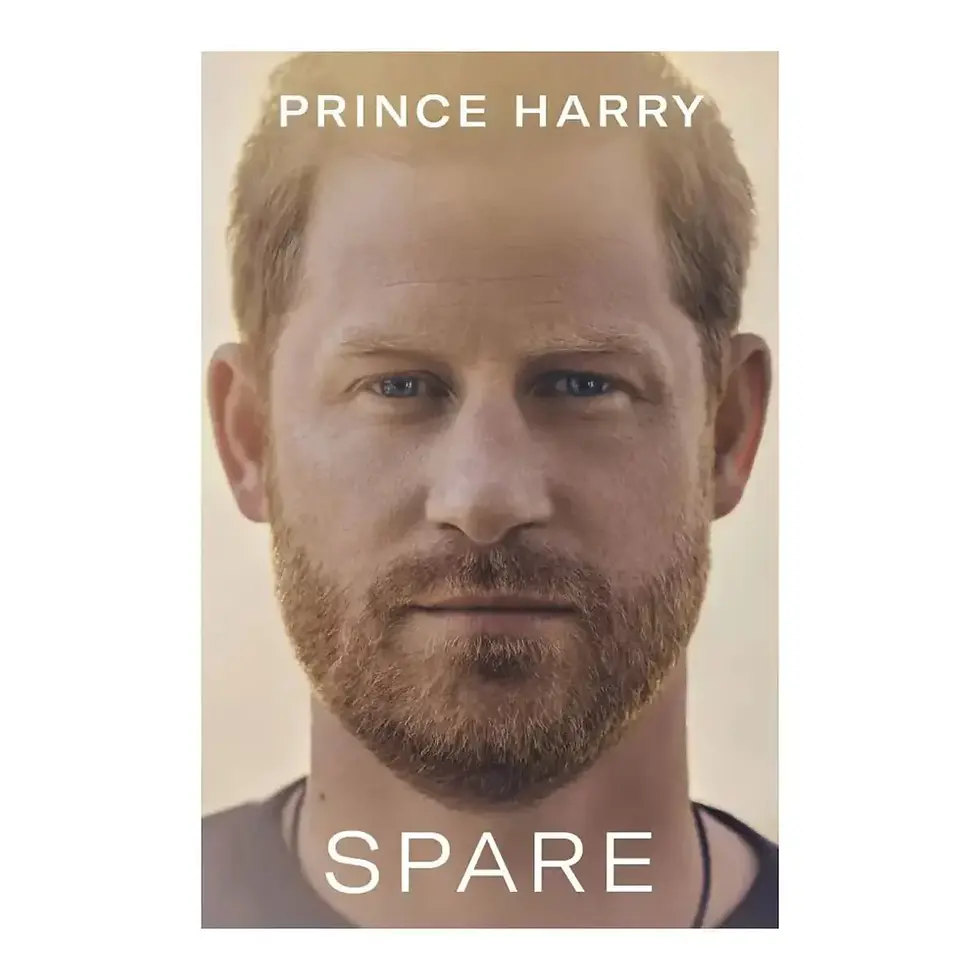
The William chapters are real. They're just not the point. Spare is a grief memoir — about a twelve-year-old at Balmoral who wasn't allowed to fall apart, and what thirty years of that costs a person. Once you see it that way, the rest of the book clicks into place.
Key Takeaways
The title is the thesis. "The spare" isn't a nickname. It's a job description. Harry's argument is that he spent thirty years performing it before he finally quit.
Unprocessed grief doesn't disappear. It relocates. Every crisis in Harry's adult life — the substance use, the rage, the recklessness — traces back to a twelve-year-old at Balmoral who wasn't allowed to fall apart.
The tabloid press is framed as the real villain. Not William. Not Charles. The British media machine — the one Harry argues killed his mother and came for his wife.
Silence is institutional armour, not dignity. "Never complain, never explain" is a policy. It protects the palace. It costs the people inside it.
Meghan and therapy are the exits. Not escapes — exits. There's a difference. One implies running. The other implies choosing.
Nobody tells you that the most famous memoir about the royal family is actually about grief. They tell you it's about Harry and Meghan. About William. About who said what at which dinner. The tabloid angle is real — but it's not the engine. The engine is a twelve-year-old boy who wasn't allowed to cry at his mother's funeral and carried that weight for the next three decades. That's the book. The palaces are just backdrop.
Who Should Read Spare?
Read it if you've ever had to perform okayness you didn't feel. If you've stayed too long in a role that didn't fit because leaving felt like betrayal. If you've watched someone absorb punishment from an institution that needed them quiet.
Read it if you care about mental health — not as a trend, but as the actual cost of not dealing with things.
And if you're a J.R. Moehringer reader who loved Open, you'll recognise the bones of this book immediately. Same emotional architecture. Different sport.
What Is Spare About?
Spare is a memoir by Prince Harry, Duke of Sussex, published 10 January 2023, co-written with Pulitzer Prize-winning ghostwriter J.R. Moehringer. The book covers Harry's childhood in the British royal family, two tours of Afghanistan, his relationship with Meghan Markle, and the couple's departure from royal duties in 2020. The central argument: the royal institution's culture of silence, combined with an unchecked tabloid press, caused real and lasting harm to the people living inside it.
The title is drawn from "an heir and a spare" — the blunt royal shorthand for the purpose of a second child. Harry's point is that this label was not just descriptive but formative. It shaped what was expected of him, what was permitted, and what he was required to suppress.
Diana's death in 1997 — when Harry was twelve — runs through the book as its emotional spine. He was at Balmoral when he learned she had died. The grief that followed, he argues, was never allowed to land properly. The institution doesn't have a protocol for grief. It has a protocol for appearances. Every chapter that follows is, in some way, the consequence of that.
Spare Book Summary
Childhood: The Role Assigned Before You Could Refuse It
Growing up second, Harry felt the weight of a script written before he arrived — insurance policy, understudy, the one who got to be charming because he'd never have to be king.
What makes this section land is the specificity. Not abstract concern about media intrusion.
Actual incidents, from early adolescence. Harry draws a direct line between the tabloid attention he experienced as a teenager and the mental health difficulties that followed in adulthood. That's not a surprising argument — but it's a more clearly drawn line than most public figures are willing to draw.
The drug use and drinking at Eton are addressed directly. He doesn't romanticise them. He frames them as the predictable output of an adolescent with unaddressed grief and no emotional infrastructure. You can agree with that framing or push back on it. Either way, it's more honest than most.
Military Service: The First Place He Felt Like a Person
The army sections are the most underrated part of this book. Possibly because they're the least dramatic.
Harry describes the military as the first institution in his life where rank — not blood — determined how you were spoken to. That clearly still matters to him. He writes about two tours of Afghanistan with a candour unusual for someone at his level of public exposure. And his account of returning to royal life afterwards — from real-world consequence back into ceremony — is where the writing gets genuinely sharp.
This is also where the tabloid picture comes into focus. Fabricated stories. A palace that responded to his concerns with something between disinterest and strategic silence. The pattern establishes itself here.
Meghan: The Clarity She Provided
Harry doesn't present Meghan as someone who changed him. He's more precise than that. She helped him see clearly what had always been wrong.
The racism directed at Meghan by sections of the British press is documented with specificity. Incidents named. Connections drawn. His argument is that leaving wasn't a lifestyle upgrade — it was a response to watching history prepare to repeat itself.
The William and Charles sections are what everyone came for. In context, they read less like revenge and more like a man trying to reconstruct, in public, how important relationships broke. He doesn't always succeed. Some of it reads like unfinished argument rather than genuine reflection. But that's also what makes it credible.
The Exit: Freedom Is Messier Than It Looks
The Sandringham meeting in January 2020. The negotiations. The move to North America. Harry writes about all of it — including the financial uncertainty of a decision that looked, from the outside, like a comfortable departure.
The ending of the book isn't triumphant. It's unresolved. That's either unsatisfying or the most honest thing about it, depending on your tolerance for open endings.
Key Lessons from Spare
1. What You Don't Process, You Perform
Harry's clearest argument is therapeutic. Not being allowed to grieve Diana properly didn't eliminate the grief — it redirected it. Substance use, rage, risk-taking he couldn't explain at the time. If you're not dealing with something, you're dealing with it sideways. The question is just which direction it comes out.
2. Institutions Are Wired for Self-Preservation First
"Never complain, never explain" isn't dignity. It's a risk management policy. Harry's account of the palace repeatedly choosing to protect the institution over the individuals inside it is the book's most transferable argument. You've probably worked somewhere that made the same trade-off. You just didn't call it royal protocol.
3. The Label Isn't the Person
"The spare." "The fun one." "The soldier." Harry accepted versions of himself that others had written and wore them for decades. His exit is framed — sometimes awkwardly, but honestly — as a belated act of self-definition. The question it leaves you with is simple: which version of yourself are you still performing for someone else's benefit?
4. In Certain Environments, Asking for Help Is an Act of Defiance
Therapy is presented as life-saving — and as something Harry had to fight to access in a culture where emotional disclosure was treated as weakness. The book doesn't just advocate for mental health support in the abstract. It shows the specific cultural resistance that makes getting help genuinely hard for certain people in certain environments. That's more useful than a general endorsement.
5. The Tabloid Argument Deserves Serious Engagement
Most coverage of Spare treats Harry's media critique as self-serving grievance. It's fair to note that a man with a Netflix deal isn't entirely outside the attention economy. But the specific claims — about Diana, about Meghan, about the palace's relationship with the press — are worth engaging with substantively. You don't have to agree to take the argument seriously.
How to Apply These Ideas
This is a memoir, not a manual. But the themes don't stay on the page.
If you're carrying unprocessed grief, Harry's story is a clear case study in what happens when you don't deal with it. Worth asking: what are you deferring, and where is it coming out?
If you're inside a system that expects your silence, the book gives you language for naming that dynamic honestly. Naming it is the first move.
If you're in a role that no longer fits, Harry's exit — messy, public, financially uncertain — is a reminder that leaving is survivable. The discomfort of going is usually smaller than the long-term cost of staying.
If you're still resistant to therapy, this is a high-profile endorsement from someone raised in a culture that actively pathologised it. File it accordingly.
About the Author
Prince Harry, Duke of Sussex (born 15 September 1984) is the younger son of King Charles III and the late Diana, Princess of Wales. He served a decade in the British Army, completing two operational tours of Afghanistan. Before stepping back from royal duties in 2020, he held a number of honorary military appointments. He and his wife, Meghan, Duchess of Sussex, co-founded the Archewell Foundation — focused on mental health, digital safety, and community work.
Spare was co-written with J.R. Moehringer, a Pulitzer Prize-winning journalist also known for ghostwriting Andre Agassi's memoir Open (2009). Moehringer is credited in the acknowledgements. He doesn't get a cover credit.
Verdict: Is Spare Worth Reading?
Here's the honest answer: yes. But not for the reason most people read it.
The William and Charles material is real — it's in there. But if that's all you came for, you're going to miss the actual book, which is a grief memoir with a palace backdrop and Moehringer's fingerprints on every page.
The prose is tighter than it has any right to be. The emotional architecture holds. Harry's account of returning from Afghanistan to royal life is, quietly, some of the sharpest writing in the book — and the least talked about.
Where it struggles: Harry is an unreliable narrator in the way all memoirists are. Some passages read more like active argument than genuine reflection. There are moments where his own choices go largely unexamined.
You're allowed to find this book both moving and one-sided. Both things are true.
Read it if you're drawn to memoir, mental health, or the question of what it actually costs to perform an identity you didn't choose.
Frequently Asked Questions
What is Spare by Prince Harry about?
Spare is a memoir by Prince Harry, Duke of Sussex, published in January 2023. The book covers his childhood in the British royal family, his military service including two tours of Afghanistan, his relationship with Meghan Markle, and the couple's decision to step back from royal duties in 2020. It was co-written with Pulitzer Prize-winning ghostwriter J.R. Moehringer.
Who ghostwrote Spare?
Spare was co-written with J.R. Moehringer, a Pulitzer Prize-winning American journalist and author also known for ghostwriting Andre Agassi's memoir Open (2009). Moehringer is credited in the book's acknowledgements. His name does not appear on the cover.
Did Spare break any sales records?
Spare was widely reported to have broken first-day sales records on publication in January 2023, making it one of the fastest-selling non-fiction books in UK publishing history at the time of release.
Is Spare worth reading?
For readers interested in memoir, mental health, or royal family dynamics, Spare offers a candid first-person account with notably strong prose. Critical reception was mixed: many reviewers praised its emotional honesty, while others noted its one-sided perspective and limited self-accountability on Harry's part.
How does Spare differ from Finding Freedom or The Crown?
Spare is a primary-source memoir written by Prince Harry himself. Finding Freedom by Omid Scobie is a biography based on sources close to the Sussexes. The Crown is a fictionalised Netflix drama. Spare covers similar ground but from an unmediated first-person perspective, with greater focus on Harry's interior life and mental health.


